Huntington, WV · Garage Door Service
Kenova homes mostly went up in the 1956-1976 window, which means older torsion and extension spring setups. Here's what actually fails and what it takes to fix it.
There's no flat number to quote here, because a broken spring on a house built in 1956 is a different job than one on a house built in 1985, even a few streets apart. What changes the bill is whether you've got a single door on a two-spring torsion bar, a single extension spring from the older end of that build window, or a double door carrying more spring weight than the original hardware was ever sized for. Homes on this side of the service area, about 8 miles out from our Huntington shop, split across both setups depending on when that stretch of Kenova filled in. We look at spring type, door weight, and how the drum or pulley wore before we say a number, not before. If you've had work done on the opener or track recently, tell us - it changes what we check first. We don't invent a price on the phone for a door we haven't seen, and we'd rather lose five minutes confirming the setup than quote wrong and eat the difference on the truck.
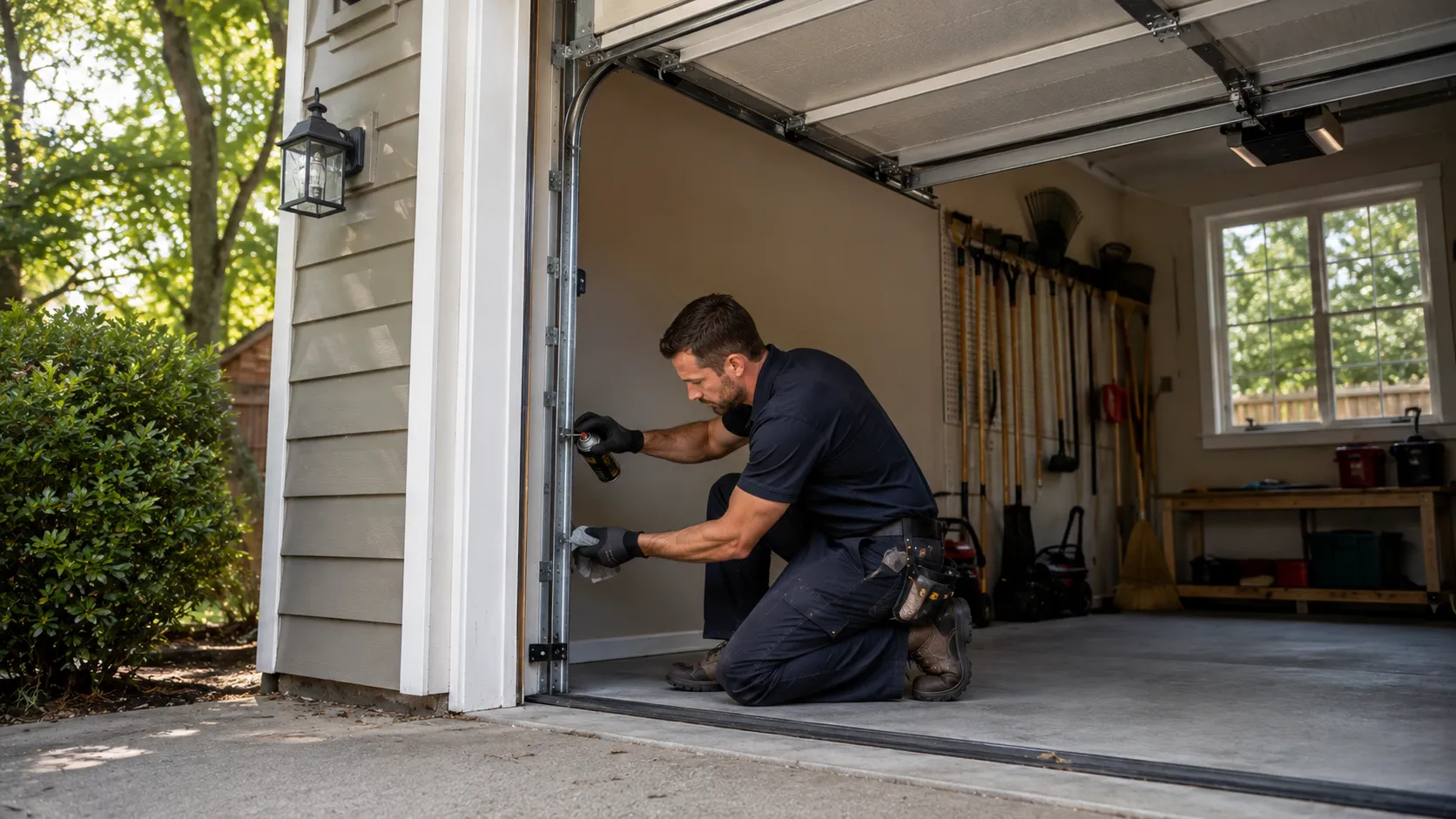
Torsion springs get unwound with bars, not by hand, and on the older extension-spring doors still common from that 1956-into-1970s stretch, we're working with a different cable and pulley arrangement that doesn't forgive a shortcut. Once the spring's off tension, we check the drum, the cable ends, and the track alignment before we put new torsion or extension springs on - because a fresh spring on a bent track just fails again in six months. On the wound-tighter old torsion setups we sometimes find, we're also checking the center bearing plate, since that's usually the second thing to give once the spring itself is gone. Where the door's original hardware is still on it, we match spring wire size and wind to the door weight rather than guessing off a chart, because a 1960s door and a 1990s door in the same size opening don't weigh the same. We test the balance by hand before we call it done, not just by running the opener.
The complication in Kenova isn't the spring itself - it's what's attached to it. On houses from the earlier end of the 1956-1996 build range, we run into single-spring torsion setups that were never rated for the door weight once a heavier insulated panel got swapped in at some point over the decades. That mismatch means a spring that looks fine can be under-tensioned for the door it's holding, and it fails faster than it should. We also see original cable and pulley hardware that's outlasted three or four spring replacements, and at some point the drum itself is worn enough that a new spring won't hold balance no matter how well it's wound. Being honest about it: if the drum, track, or opener mount is bad enough, replacing the spring alone is a bad use of your money, and we'll tell you that instead of just swapping the part you called about.
Most of the garage doors we get called to in Kenova sit on houses built between 1956 and the mid-1970s, which puts a lot of this stretch of the service area right in that older torsion and extension-spring generation before lighter, better-balanced hardware became standard. With roughly 1,460 households in Kenova, that's a smaller, older pocket than some of the newer-built areas we cover, and it shows in the calls - more original hardware, more doors that have had one spring replacement already and are due for a second. The cold winters here work against aging springs too: metal fatigue moves faster with repeated temperature swings, and a spring that's been wound since the Carter administration doesn't get a pass because it's mild out. Median household income in Kenova runs around $53,438, a touch under the wider service area's $54,135, which is part of why we try to fix what can be fixed instead of pushing a full door replacement.
We run out of Huntington, about 8 miles from Kenova, so there's no branch office here - just a truck that comes out with the bars, gauges, and spring stock to handle torsion and extension jobs on the spot. Have the door's rough age and whether it's single or double ready when you call; if you know the house was built in the 1960s or 70s, that alone tells us which hardware generation we're probably dealing with before we even pull up. We'd rather ask two extra questions on the phone than show up with the wrong spring size in the truck.
Don't do this one yourself. A wound torsion spring holds enough stored force to break a bone or worse if the bar slips, and extension springs on the older Kenova-era doors can whip loose from a worn pulley with no warning. Where a homeowner can help themselves is in catching the warning signs early - a door that's suddenly heavier to lift by hand, a loud bang from the garage, a door that won't stay up on its own - and calling before the cable or drum takes damage too. That's the difference between a spring-only job and a bigger one. Beyond spotting those signs and keeping the track area clear of stored junk that can get knocked into it, there isn't much else worth doing here without the tools for it.
A lot of Kenova's housing dates to 1956 through the mid-1970s, which means older torsion or extension spring setups are common. That era's hardware often wasn't sized for heavier replacement panels installed later, so a spring can fail faster than a newer door's would. Knowing the house's build decade helps us bring the right spring before we even see the door.
No. We run out of Huntington, about 8 miles away, and drive out for the job. There's no local branch or drop-in counter here, just a truck stocked for torsion and extension spring work in the door types common to this area.
Sometimes. If the drum, cable pulleys, or track are worn out along with the spring - which happens on older original hardware that's had a couple of spring swaps already - putting in just a new spring is a short-term fix. We'll say so instead of quoting a spring-only job that won't hold.
Cold, moderate-climate swings put repeated stress on metal that's already fatigued, and a lot of Kenova's springs are on hardware from the 1960s and 70s. A spring that's held for decades doesn't get weaker gradually and evenly - cold snaps tend to be when the last bit of wear finally gives.
Call now or request a free quote - same-day service on most repairs, upfront written pricing.